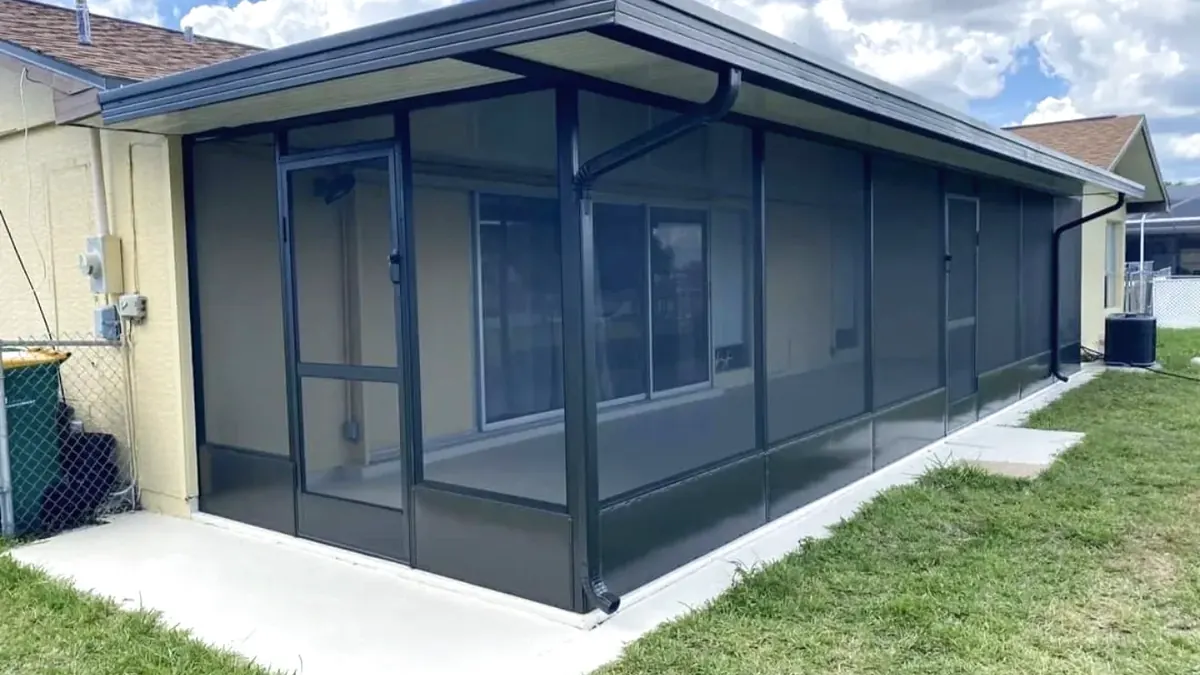
The gaps along the top of a new screen enclosure: normal, or did they rush it?
The short version
- A screened enclosure is aluminum sections bolted and fitted together, not a sealed box, so a consistent hairline gap where a wall section meets the roof is usually normal, not a mistake.
- Press on the seam and check whether the gap stays the same width all the way around the enclosure. Even and unmoving is the sign of a normal build.
- A missing trim piece, mesh that is not seated in its groove, a skipped run of fasteners, or a panel that sits crooked are the signs that something was actually missed.
- Describe what you see and ask what it is instead of leading with an accusation, and most of the time the honest answer is that is how it was built.
You just paid real money to have the enclosure rebuilt, and the first thing you notice afterward is a gap. It runs along the top edge, right where the wall sections meet the roof, thin and even, all the way around the cage. You never looked closely enough at the old one to know if it was ever sealed tight there either. Now you are standing in the yard wondering if you are about to be the customer who calls back over nothing.
A homeowner in Cape Coral asked almost this exact question after a post-storm rebuild, describing "a gap where the vertical wall sections meet the roof, all the way around." They had already used a licensed, established contractor. They were not looking for a reason to be upset. They wanted to know if this was normal before they made it into something.
We build and rebuild these enclosures ourselves, so take the next few sections knowing who is talking. Most of what gets flagged as a gap is exactly how the structure is supposed to go together. Some of it is not, and it is worth knowing which one you are looking at before you pick up the phone.
An enclosure is bolted together, not poured as one piece
A screened enclosure is aluminum sections, extruded and cut to length, connected with screws, spline and fitted corners. It is not a fiberglass shell or a poured room with a lid. Every wall section meets the roof at a joint, and a joint is two separate pieces of metal doing two separate jobs, not one continuous surface. Where two separate pieces meet, there is almost always a reveal. That is true of the enclosure over your pool, and it is true of the siding on your house.
Where a wall section meets the roof, the wall's top rail sits under a receiving channel on the roof beam, and the two are drawn together with fasteners, not glue or weld. Even a well-set channel leaves a visible line at that connection, because you are looking at the edge of one extrusion sitting against the edge of another. That line is the gap you are describing.
Why the seam at the roofline is not sealed shut
Aluminum moves. It expands in the heat and pulls back overnight, and a structure this size moves more across a Florida afternoon than most people would guess. A joint that was caulked airtight would eventually crack that seal anyway, because the metal on either side of it is not moving in step. A hairline reveal at the wall to roof seam lets the frame make that small amount of movement without fighting itself.
Water is the other reason. Rain that lands on the roof panels has to go somewhere, and the gap at that seam is often part of the path, not a hole in it. A sealed seam would hold water against the frame instead of letting it drop straight to the ground below. The gap is doing a job, even though it looks like something got left undone.
The wall goes up first and gets plumbed and squared before the roof beams ever land on it. That order matters, because it means the top of the wall is fixed in place before the roof connection is made, not adjusted to force a tight fit against it. A crew working carefully sets that connection once and leaves it alone, rather than caulking over a line that was never meant to disappear.
What a normal gap looks like on your own enclosure
Walk the seam where the wall meets the roof, corner to corner. Normal looks the same width the whole way around, not wide in one spot and closed in the next. Press a hand against it and the panel should not shift or flex under light pressure. Look along it at an angle and you should not see a straight, open sightline through to daylight, just a narrow line between two pieces of metal.
That kind of gap does not grow. It looked the same on the day the crew finished as it does now, and it will look the same next year. If what you are seeing matches that description, the honest answer is that it was built the way this kind of structure gets built, and nobody skipped anything.
What actually points at a section that got missed
A few things really are not normal, and they look different from a reveal once you know to check for them. A closure or trim piece that was never installed leaves a raw, unfinished edge instead of a finished line, sometimes with the cut end of the metal still showing.
Mesh that never seated in the spline groove shows up at that same seam as screen you can lift with a finger instead of screen that stays put. That is a small fix, not a structural one, and it is exactly what screen repair in Cape Coral is for.
A run of fasteners that skips is easier to miss, because it sits at eye level or above. Screws along a beam should hold a steady spacing. A long stretch with nothing holding it is a step that got missed, not a design choice.
A panel that does not sit square shows up as a gap that changes width as you follow it, wide at one end and tight at the other instead of even the whole way. That usually means the panel went in slightly rotated before it was fastened down. Straightening or resetting a panel like that is a repair, not a full rebuild.
How to look before you call
Do this before you pick up the phone, so you are describing something specific instead of a feeling. Walk the full perimeter at the roofline. Photograph the seam at each corner and one spot mid-wall. Press on a few sections and note whether anything moves. Compare the photos against each other, corner to corner, rather than against a memory of an old cage you already admit you never really examined.
If every photo looks the same, you likely have your answer already. If one section stands out from the rest, that is the one to ask about, not the whole enclosure.
Asking about it without starting a fight
The hard part is the phone call. Describe what you see instead of what you suspect. Something like, "there is a gap along the top on the west wall, wider than the other three, is that normal," gets you an answer. Leading with an accusation about a rushed job gets you a conversation about being difficult instead, and the actual question gets lost in the middle of it.
Asking is not being difficult. A lot of these enclosures are going back up around Cape Coral at once, and a backlogged crew can still set a tight, consistent seam. A plain question about the gap does not accuse anyone of rushing.
Most of the time, the honest answer is that it is how the enclosure was built, and you hang up knowing that instead of wondering about it every time you walk outside. A busy contractor would still rather answer a plain question in a couple of minutes than have you post about it online instead of calling. If the gap changes from wall to wall, or if what you are seeing matches the missing trim or crooked panel above, that is worth a closer look, and a second opinion from another contractor is a reasonable next step, not an accusation.
If you want another set of eyes on it, describe what you are seeing and we will tell you plainly whether it is normal or worth a fix. We do pool cage and screen enclosure work around Cape Coral, and telling a customer a gap is fine costs us nothing, so there is no reason for us to say otherwise.